Project 09 · AME 585 · Graduate Aerospace Structures
NASGRO Crack Propagation Analysis
AME 585 · Graduate Aerospace Structures · University of Southern California · Spring 2025
Course
AME 585 — Grad Aerospace Structures
Team
Glover · Kim · Ousman
Software
NASGRO v7.11
Materials
Al 2024-T3, Al 7075-T6
Geometries
TC07, SC11, EC01, TC16
What is NASGRO?
NASGRO is a fracture mechanics software suite developed by NASA and Southwest Research Institute (SwRI) for analyzing crack growth and fracture in aerospace structures. It implements the NASGRO crack growth equation — an extension of the Paris Law — which accounts for stress ratio effects, crack closure, threshold behavior, and near-fracture acceleration that simple Paris Law models miss.
Given a geometry, material, load spectrum, and initial flaw size, NASGRO computes the critical crack size (CCS) at which fracture occurs, the fatigue life in cycles before failure, and a full crack growth history. It contains a library of standard aerospace geometries (TC, SC, EC series) that map to real hardware — pressurized pipes, fuselage skins, valve bodies — making it the industry standard tool for fracture control plan compliance per NASA-STD-5019A.
Pressurized Pipe — TC07 Critical Crack Size
A thin-walled aluminum pipe (Al 2024-T3) under internal pressure was analyzed using NASGRO geometry TC07, a through crack in a pressurized cylinder. With R = 2 in, D = 4 in, t = 0.1 in, and KIC = 22,000 psi√in, a factor of safety of 1.4 reduced the effective toughness to Kcr = 15,714 psi√in. NASGRO's Regula Falsi iteration converged on a critical half-crack length of c = 6.667 × 10⁻³ in, a maximum allowable flaw of 2c = 0.0133 in. The applied stress exceeds the alloy's yield strength, so the pipe would yield before it fractures. Even considering fracture alone, a 0.0133 in allowable flaw is below reliable NDE detection limits, so the design is not flaw tolerant and requires a thicker wall or a lower operating pressure.
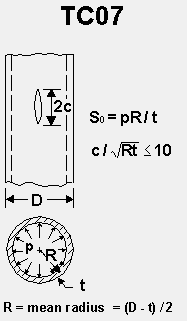
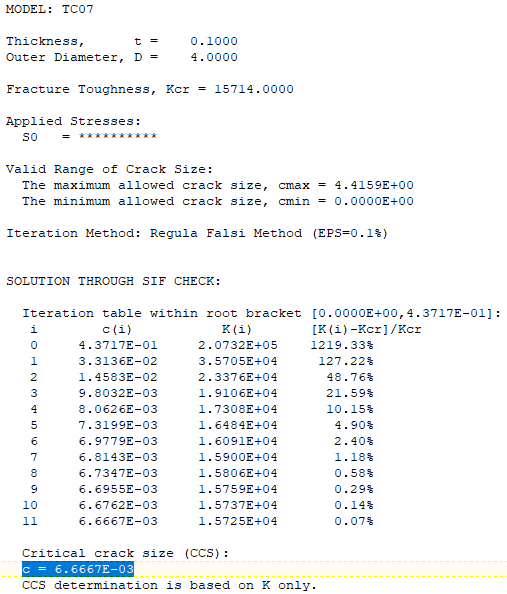
TC07 geometry schematic · NASGRO iteration output — CCS = 6.667×10⁻³ in
Flat Plate with Loaded Hole — SC11 Flaw Acceptability
A flat plate (Al 2024-T3, t = 0.1 in, W = 20 in) with a loaded hole and surface flaw (a/c = 0.5, geometry SC11) was evaluated for flight acceptability. The existing flaw size is c = 0.5 in with a bearing load of 1000 lbs (S₀ = 20 ksi, S₃ = 50 ksi). The initial hole diameter D = 0.5 in triggered a NASGRO geometry error (D/t ratio out of range), requiring a conservative adjustment to D = 0.2 in to proceed.
NASGRO computed a critical crack size of a = 1.281 × 10⁻² in, c = 2.503 × 10⁻² in. Since the existing flaw (c = 0.5 in) far exceeds this CCS, the answer is clear: the part is not safe for flight and must be rejected or repaired.
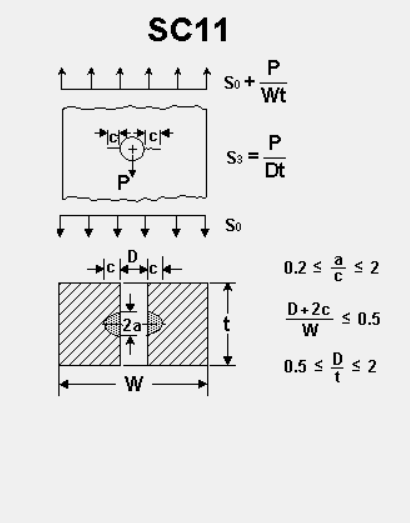
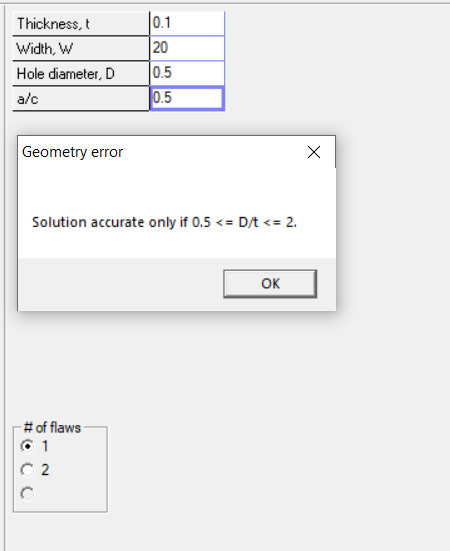
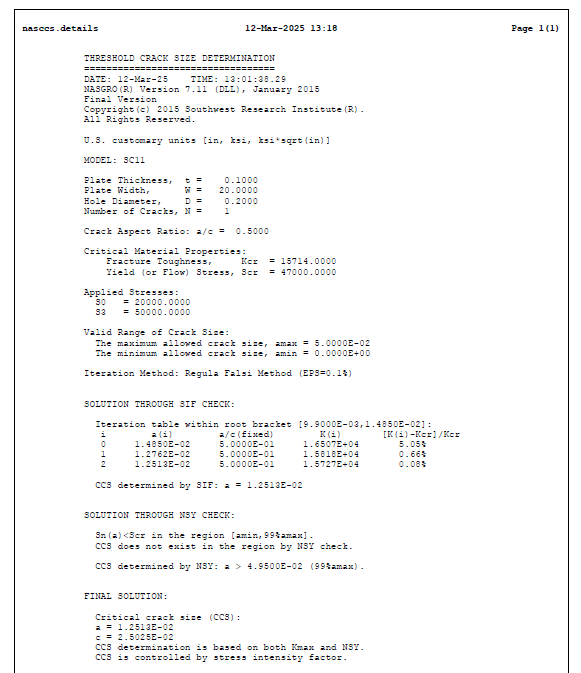
SC11 geometry · Geometry boundary error (D/t) · NASGRO CCS output — flaw unsafe for flight
Valve Fatigue Life — EC01 Crack Growth to Failure
A cyclic fatigue life analysis was performed on an Al 7075-T6 valve body using NASGRO geometry EC01 — an embedded elliptical crack in a finite plate under uniaxial stress. With t = 0.1 in, w = 0.56 in (from 2c/W ≤ 0.5 constraint), and an NDE-detectable initial flaw consistent with radiographic inspection (X-ray 5009), a proof factor of 1.5× was applied.
NASGRO predicted failure at cycle 10,511, with a final crack size c = 0.210 in. The valve service life requirement is 10,000 cycles, meaning the part just barely exceeds its target — but applying a 4× factor of safety reduces the allowable life to 2,500 cycles, confirming the current design does not meet safe-life requirements under fracture control criteria.
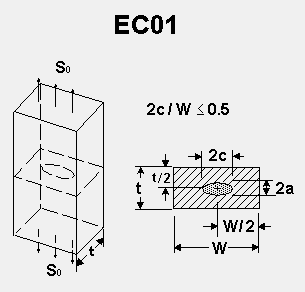
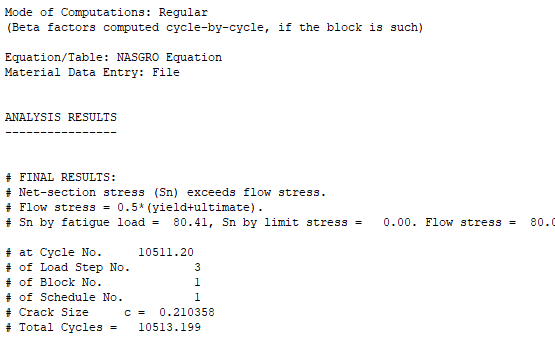
Pressurized Fuselage Skin — TC16 Crack Growth Life
A pressurized aircraft fuselage skin was analyzed using NASGRO geometry TC16 — a through crack in a thin curved stiffened panel with bulging correction. The aircraft flies at 40,000 ft with a cabin pressurized to 7,000 ft equivalent, generating a hoop stress S₀ = PR/t = 8.62 ksi. Material is Al 7075-T6 (KIC = 25,000 psi√in). A 1-bay stiffened configuration with Chen + Schijve bulge factor and R+C correction was applied.
An initial target of 3,000 cycles produced a NASGRO convergence error — the target life was too low for the crack size to propagate within bounds. Adjusting to a more realistic target, NASGRO converged to an initial crack size of c(init) = 3.569 in, with an actual fatigue life of 27,026 cycles — well beyond the typical aircraft inspection interval, confirming structural adequacy for the given load spectrum.
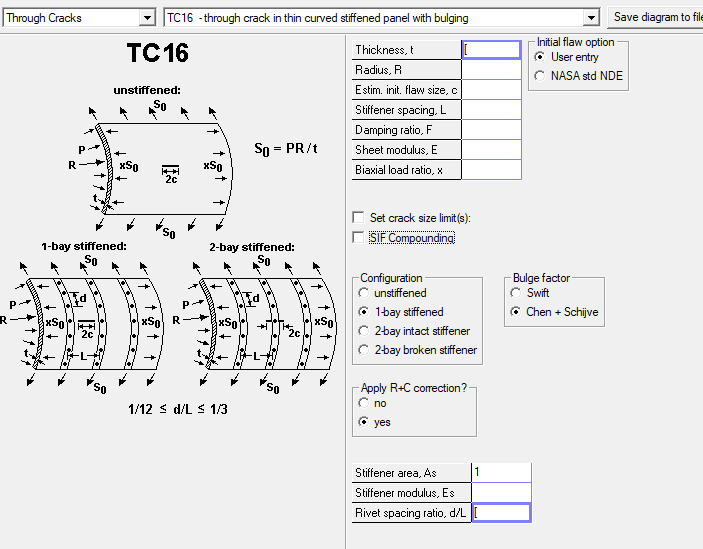
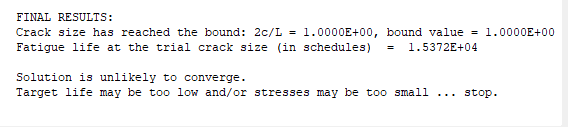
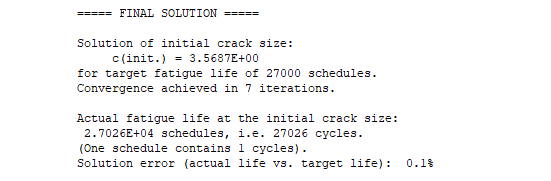
TC16 geometry setup · Convergence error at 3,000 cycle target · Final solution — 27,026 cycle fatigue life
Download
AME 585 Project 7 — Full Presentation
Complete team + individual slides · NASA 5019A fracture control plan, all NASGRO analyses, Q6 Abaqus FEA · Glover, Kim, Ousman · Spring 2025